Thad Beaumont’s writer’s block
The Dark HalfThad Beaumont’s writer’s block is the crisis that prompts him to create a separate authorial identity, George Stark. Rather than treating the pseudonym as a mere disguise, he understands it as a possible way out of creative paralysis: to write freely, he needs an identity distinct from his own.
Identity and Background
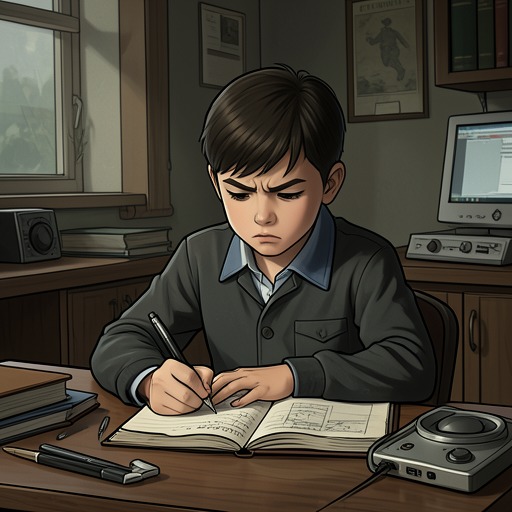
The block takes hold during the difficult interval between Thad’s first book, The Sudden Dancers, and his second. The first received more critical acclaim than royalties, and contemporaries recalled that Thad’s troubles seemed to go beyond a stalled manuscript: at least two prominent writers worried about his sanity during this period. One believed he may have attempted suicide after the book appeared. That account is explicitly presented as another writer’s belief, not as a confirmed event; Thad himself rejects the suggestion when asked and identifies writer’s block as the real problem.
The contrast between public recognition and practical reward sharpens the pressure surrounding the block. Critical approval had not delivered substantial income, while the inability to write threatened the work on which Thad’s identity as a novelist depended. His own dark joke about dead writers having a terminal case of writer’s block turns that professional paralysis into a problem with existential weight, without confirming the suicide story reported by others.
Liz’s Proposal and the Search for a Way Forward
Liz Beaumont keeps advocating for Thad to use a pseudonym. Her proposal is not simply to conceal his name: it offers him permission to write without the expectations associated with his established literary reputation and the scrutiny of The New York Times Book Review. She encourages him to try genres he might otherwise feel constrained from pursuing, including Westerns, mysteries, science fiction, and crime fiction.
Liz’s suggestion grows from her observation that George Stark was already present in unfinished work Thad had written. She describes the pseudonym as a way of drawing out something latent, rather than inventing an entirely foreign personality. At the same time, she refuses to claim sole responsibility for Stark’s emergence: she suggested writing under another name as a jump-start, but Thad had supplied the unfinished material in which she recognized signs of this possible identity.
The crime novel is the suggestion Thad places last in his account of Liz’s list, and he suspects she did so deliberately. She knew he had been turning over an idea for a crime novel, though he could not yet grasp it. The genre therefore becomes both a practical opening—a form in which he might begin writing again—and a route toward the distinct authorial persona he believes the block requires.
A Separate Identity
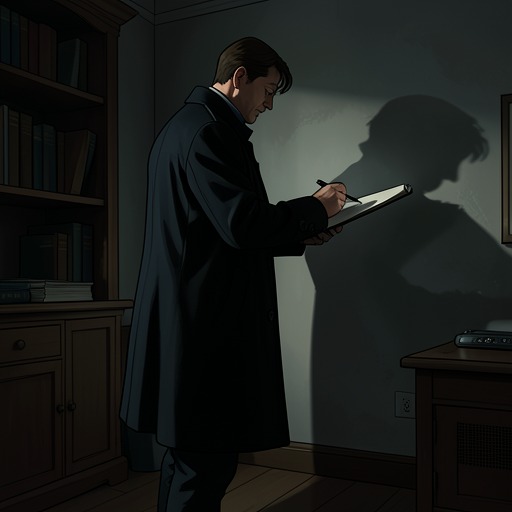
For Thad, choosing the name is the hardest part. He believes that writing could break the block if he could find the right identity: one that was separate from his own. The distinction matters because the pseudonym is not merely a label placed on an already completed book. In his account, the identity must come first, creating the conditions under which the stalled writing can move.
His explanation makes the pseudonym a response to constraint as well as a matter of style. Writing under his established name carries the weight of literary judgment; writing as someone else promises room to pursue material without the same critical gaze. Liz’s encouragement and Thad’s own need for separation converge here: her proposal gives him permission to experiment, while his insistence on a distinct identity describes what he thinks the experiment must achieve.
The Model for George Stark
Thad explains the name George Stark through the example of Donald E. Westlake, who wrote comic social crime novels under his own name and a different series under the pen name Richard Stark. The Richard Stark books, written from the early 1960s to roughly the mid-1970s, follow Parker, a professional thief with almost no interests beyond robbery. Thad is drawn to the sharp difference between Westlake’s two bodies of work and to the idea that a pen name can sustain a genuinely different kind of writing.
He also recalls Westlake’s description of the division: Westlake wrote on sunny days, while Stark took over on rainy ones. That image resonates with Thad’s own years between 1973 and early 1975, which he calls rainy days. The borrowed model makes the pseudonym feel less like a marketing device than a compartment for work produced under a different emotional and creative weather.
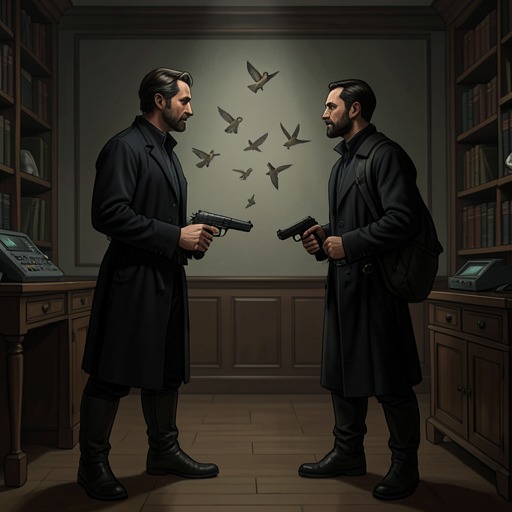
Thad’s account of Parker adds a more severe dimension to the model. In the best of the books, Parker seems less like a rounded man than a killer robot programmed toward one goal; the repeated demand for money is nearly all he says. Thad asks whether that figure recalls anyone, and the interviewer recognizes the connection: Alexis Machine, the central character in the first and last George Stark novels. The comparison shows how the model for Stark’s writing is carried into the fiction attributed to Stark.
Narrative Significance
The block is thus the hinge between Thad’s difficulty producing work and the invention of George Stark as a distinct authorial identity. Liz sees signs of Stark in Thad’s unfinished writing; Thad seeks a name and a separation strong enough to make writing possible. The resulting arrangement draws on a real-world literary example in which one writer’s two names mark sharply different creative modes, then translates that division into the Stark books and their protagonist, Alexis Machine.
The account preserves an important tension rather than reducing the block to a simple technical obstacle. Thad describes it as the immediate problem, while the recollections of his contemporaries suggest a period of deeper distress; their concern and the reported suicide attempt remain unverified claims that he denies. What is clear in his own explanation is the solution he hoped for: a crime novel written under an identity free from the expectations attached to Thad Beaumont. George Stark begins as that answer to paralysis, with the rainy-day image giving the new name both a literary precedent and a personal resonance.